


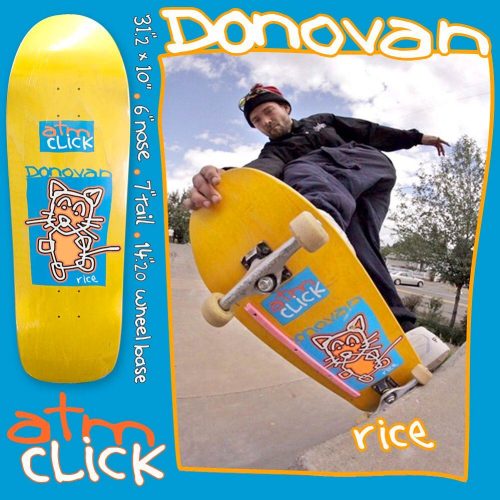
 Donovan Rice has spent decades developing the kind of skateboarding that fits the Pacific Northwest perfectly: creative, all-terrain, slightly unconventional and rooted more in having fun than following whatever happens to be fashionable. Although Rice was born in Milwaukee, Wisconsin, he grew up largely in Washington and Oregon, eventually becoming closely associated with the Portland skate scene. As a kid he moved through Vancouver, Washington, Beaverton and the small Oregon community of Donald, where skateboarding became his way of making something happen in a place where there wasn’t much for a young skater to do.
Rice started seriously skating around age ten. A major turning point came when a skatepark was built in Donald in the early 2000s. Until then, his terrain had largely consisted of streets, curbs, stairs and whatever else could be found. Suddenly there was transition, concrete and an entirely different kind of skateboarding to learn. Rice threw himself into it, developing the ability to skate both street and transition rather than settling into a single category. That versatility became an important part of his skating as he became a familiar presence around Oregon and at legendary Portland terrain such as Burnside.
There has always been something refreshingly loose about Rice’s approach. His skating doesn’t look like it was designed around a checklist of current tricks. He approaches spots with personality, finding lines, transfers and tricks that make sense to him. His attitude toward skateboarding has always seemed straightforward: keep skating, stay creative and have fun. That outlook explains a lot about both his skating and the boards that have carried his name.
In 2019, ATM Click officially turned Donovan Rice pro, giving him his first professional model. It was a fitting match. ATM Click has always occupied its own corner of skateboarding, mixing straightforward skateboarding with unusual graphics, shapes and personalities rather than trying to make everything look overly polished. Rice brought exactly that kind of individuality to the team.
His pro model immediately stood apart. Instead of a conventional popsicle shape, Rice received a wide 10-inch model measuring approximately 31.2 inches long with a compact 14.2-inch wheelbase. The dimensions gave the board an unmistakably old-school silhouette while keeping the wheelbase short enough to remain quick and responsive. Made from seven-ply maple, it offered plenty of room underfoot for transition and fast cruising while still being completely usable for the technical and unconventional tricks Rice is known for. That same basic shape has continued in the ATM lineup and remains closely identified with him.
Then there is the cat.
Cats have become almost inseparable from Donovan Rice’s skateboard graphics. Rather than treating a pro graphic as some overly serious piece of branding, his boards have repeatedly turned his love of cats into something personal, funny and immediately recognizable. His original ATM Cat model features a simple cartoon cat character placed prominently on the deck. It is the sort of graphic that feels playful and handmade, matching Rice’s skating far better than some overly complicated design ever could.
The cat theme didn’t disappear after the first board. It became part of the Donovan Rice visual identity. Later graphics continued to feature cats in different situations, including sleepy cats, houseplants and other everyday scenes. ATM has also produced the Cat graphic in different stains and colour treatments, proving how easily the artwork translates across different versions while still looking unmistakably like a Donovan Rice board.
Even graphics built around other subjects still tend to live in that same playful world. Fishbowls, household scenes, animals and hand-drawn characters all feel connected rather than random. That continuity is part of what makes Rice’s models memorable. Plenty of professional skateboarders receive a long succession of completely different graphics, but Donovan Rice has developed something closer to his own little universe.
The boards have also arrived at the right moment in skateboarding. Wider decks, shaped boards and shorter wheelbases have returned in a big way, giving skaters more freedom to choose something beyond the traditional symmetrical street deck. Rice’s 10-inch ATM shape fits naturally into that movement, but it never feels as though it was designed simply to follow a trend. He has been skating unusual terrain and approaching skateboarding his own way for years. The shape makes sense because it reflects how he actually skates.
That may be the biggest reason Donovan Rice and ATM Click work so well together. Neither seems particularly interested in making skateboarding more serious than it needs to be. Rice has built his skating around creativity, personality and using whatever terrain is available, while ATM gives him a platform that allows that personality to come through right down to the cats printed underneath his boards.
For Pacific Northwest skateboarders, Rice represents something familiar: a skater shaped by concrete parks, rough streets, rain, small-town boredom, Portland creativity and a willingness to skate whatever is available. His ATM Click pro model captures that same attitude in wood. It is wide, different, functional, instantly recognizable and covered in cats. Somehow, it couldn’t suit Donovan Rice any better.

