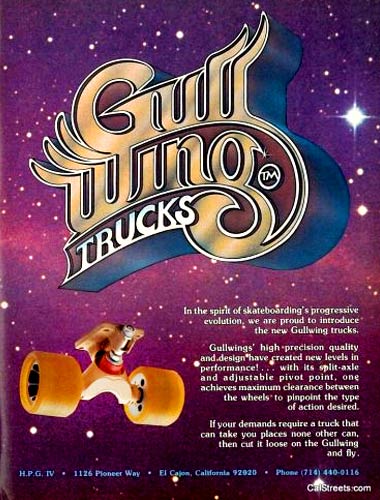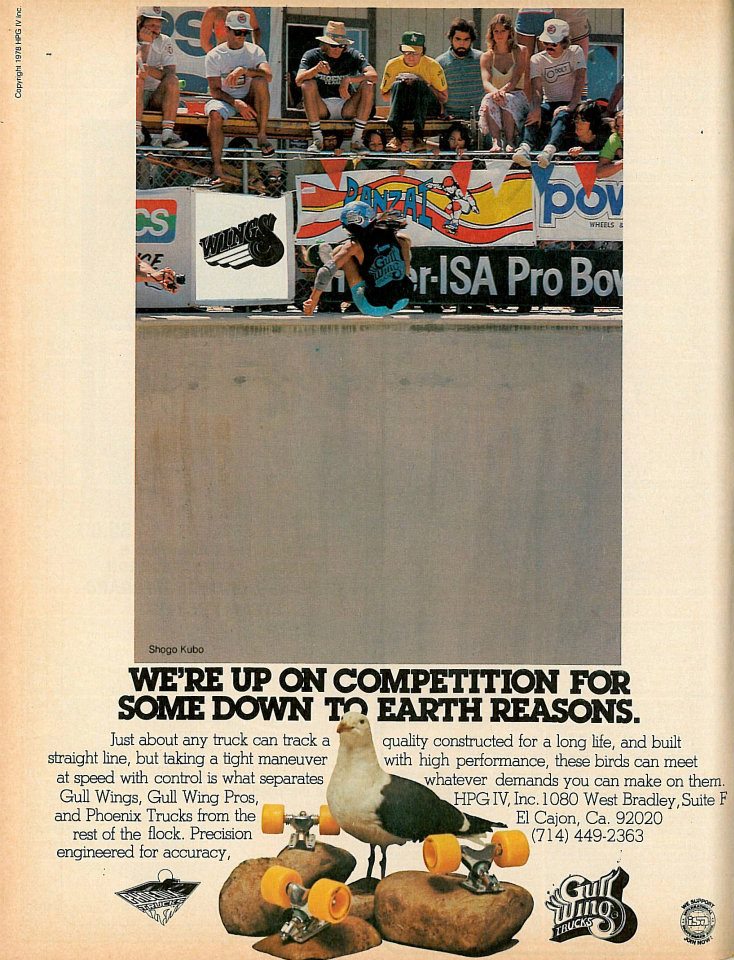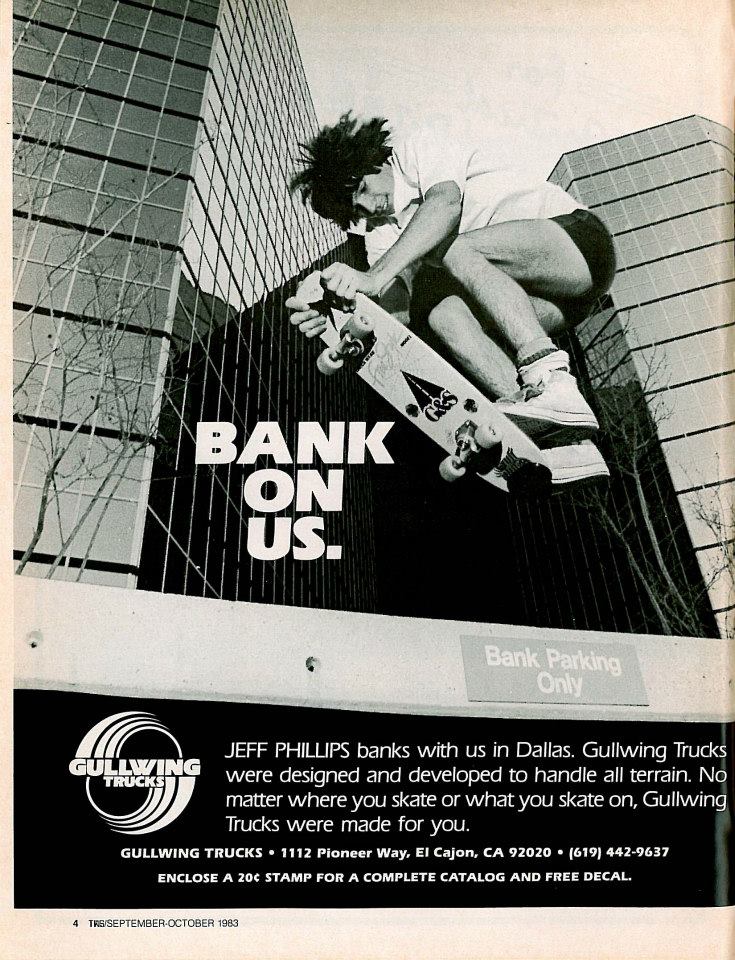
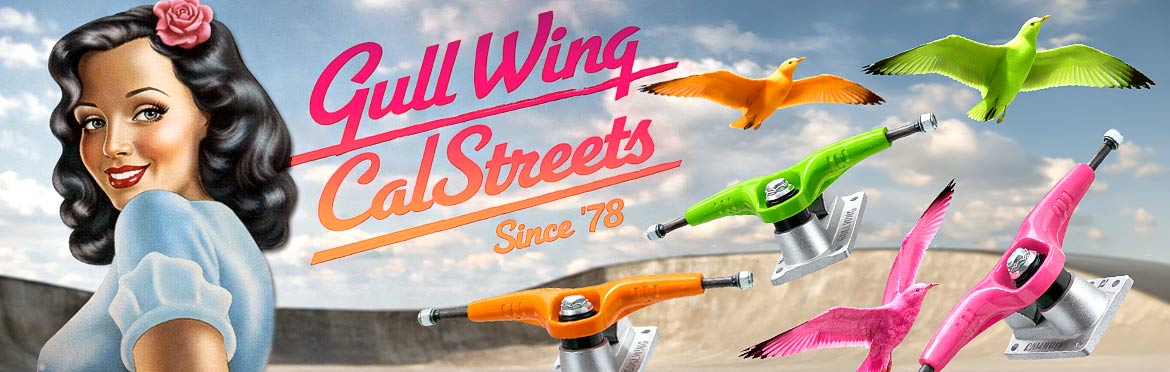


 Gullwing is one of those skateboard truck companies that feels permanently welded to the sound, look, and attitude of skateboarding’s second great explosion. While Independent, Tracker, Bennett, ACS, and later Thunder all carved out their own territories, Gullwing built its name on a different kind of promise: fast turning, high-speed stability, wild design ideas, and a team that made the trucks feel like they belonged under real skaters, not just inside magazine ads. Founded in 1976, Gullwing arrived during a critical moment when skateboarding was moving fast from toy-store novelty into a specialized, performance-driven culture. The company is widely credited with introducing the split axle truck design, a concept aimed at quicker turning and improved stability for slalom and downhill riding. That first Split Axle model set the tone for what Gullwing would become: a brand willing to engineer something different rather than simply copy what was already working.
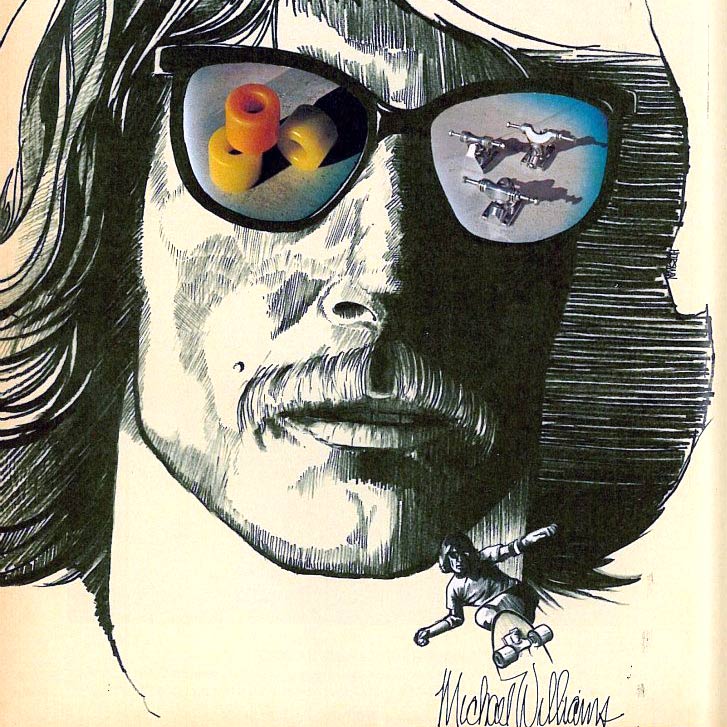
The company was established by precision designer Bill Brawner, CEO Walt Tiedge, and skaters Mike Williams and Joe Lynch, giving Gullwing an early mix of technical thinking and rider input. That mattered. In the 1970s, skateboard trucks were still being figured out in real time. Boards were getting wider, wheels were getting better, parks were opening, pools were being discovered, and skaters were demanding equipment that could survive new terrain. Gullwing’s Split Axle was designed with slalom and downhill in mind, but its success came from the way it paired fast response with control at speed. The next major model, the Phoenix, kept that same broad design language but was built tougher for pool and vert abuse, giving Gullwing a stronger foothold as skateboarding got more aggressive.
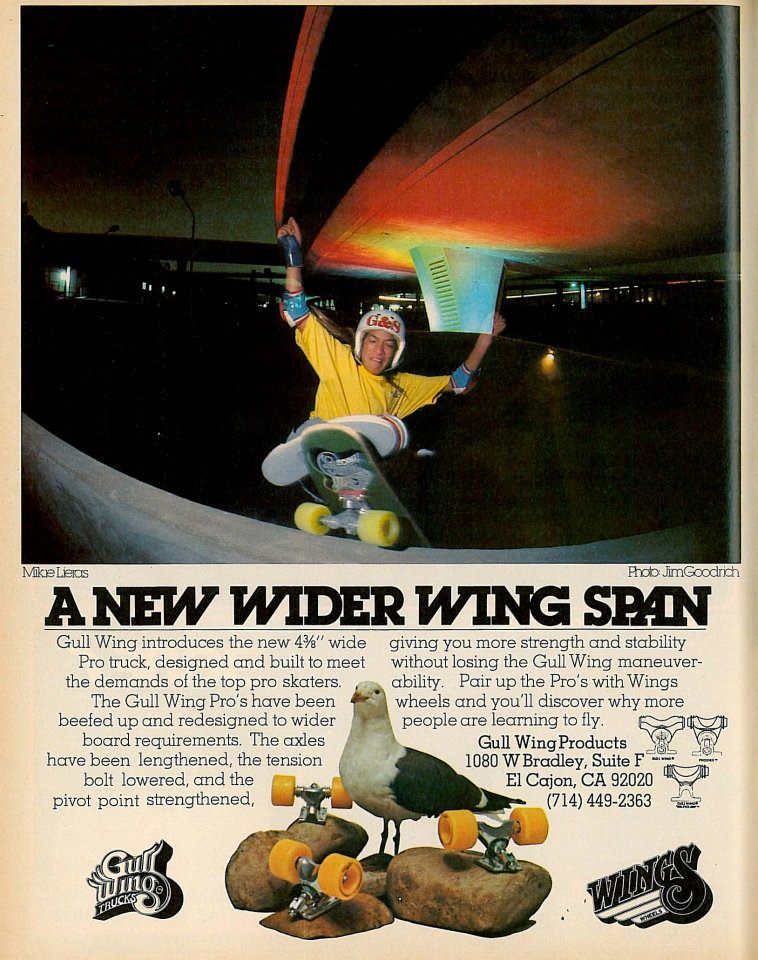
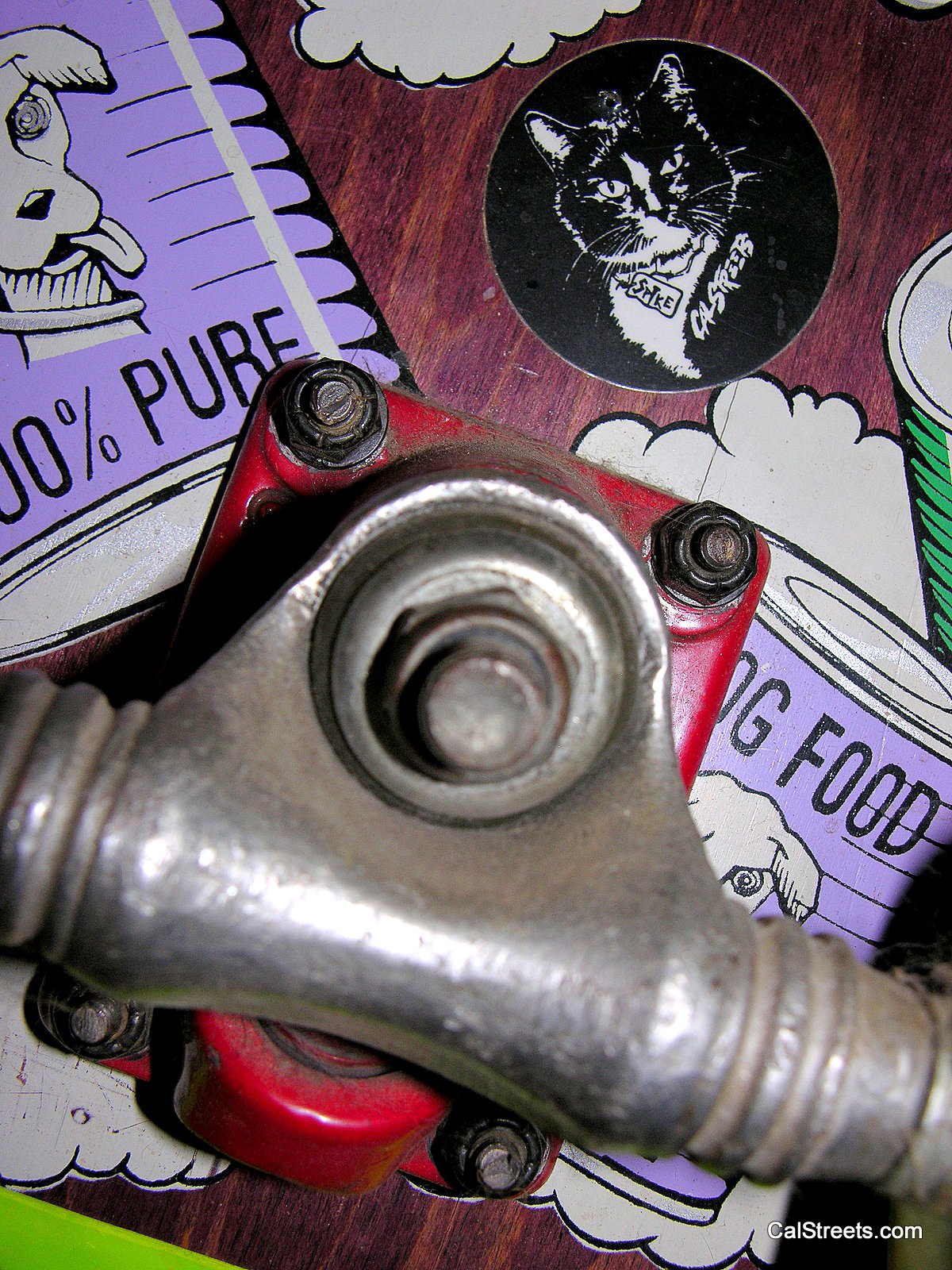
By the early 1980s, skateboarding had changed again. Vert was exploding, backyard ramps were growing, coping was being attacked harder, and grinding had become a serious part of the vocabulary. Gullwing responded with one of its most recognizable design contributions: the Gullwing Groove. The company’s Pro model featured a groove through the centre of the hanger, a strange-looking detail at first glance, but one that became associated with helping skaters lock into grinds as steel and PVC coping became more common. Whether a skater loved the way it functioned or simply loved the way it looked, the groove became part of the brand’s identity. It gave Gullwing trucks a visual fingerprint. You could spot them under a board from across the ramp.
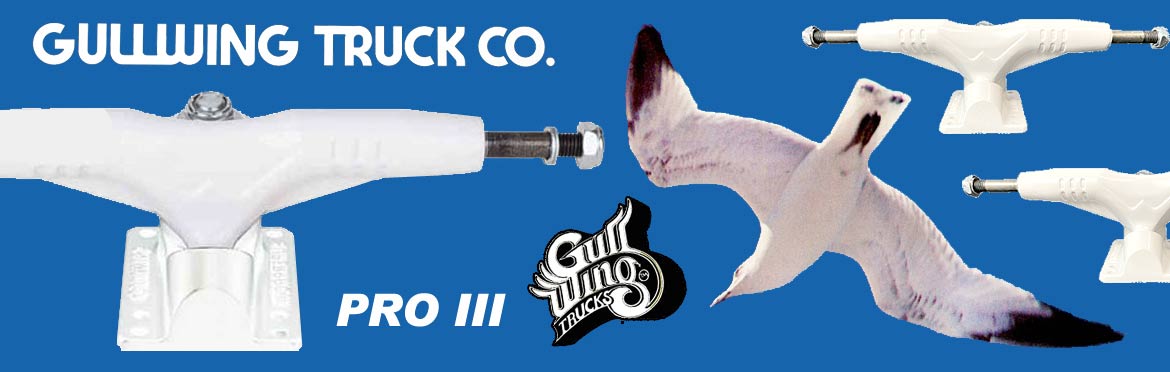
The Pro III became the truck that burned Gullwing into 1980s skateboarding memory. Introduced in the mid-1980s, the Pro III is often described as one of the most popular and successful trucks of that era, especially among skaters building big, loud, graphic-heavy setups for vert, pools, street plants, curbs, and early street terrain. The Pro III had presence. It looked right under wide decks, reissue shapes, pig shapes, fishtails, and anything that needed a truck with enough meat to match the attitude of the board. For many skaters, the Pro III was not just a truck. It was part of the whole 80s silhouette: big deck, bright plastics, rails, risers, loud wheels, and trucks that looked like they could take a coping slap without crying about it.
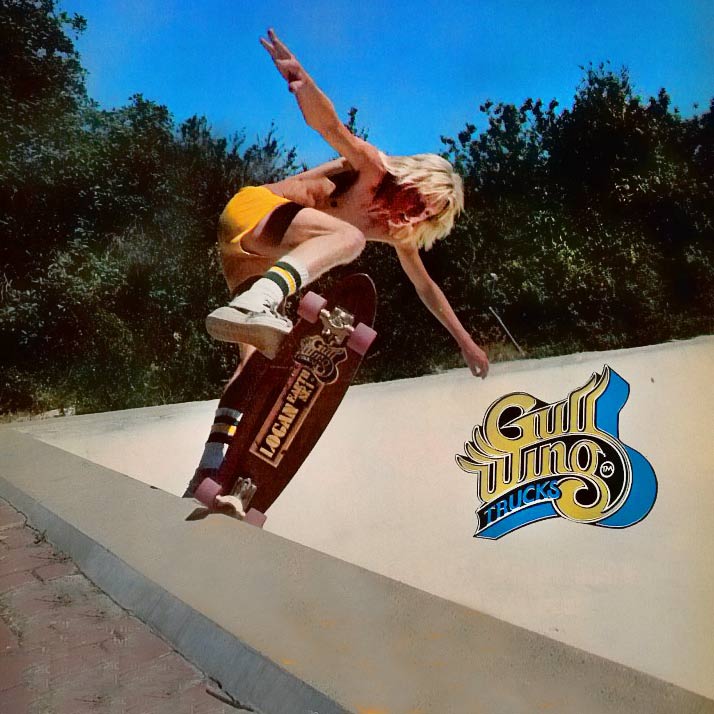
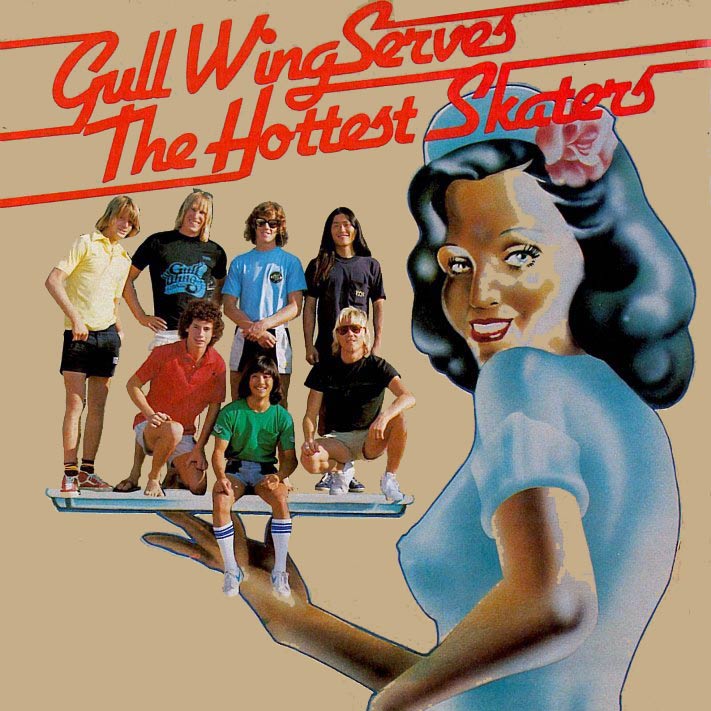
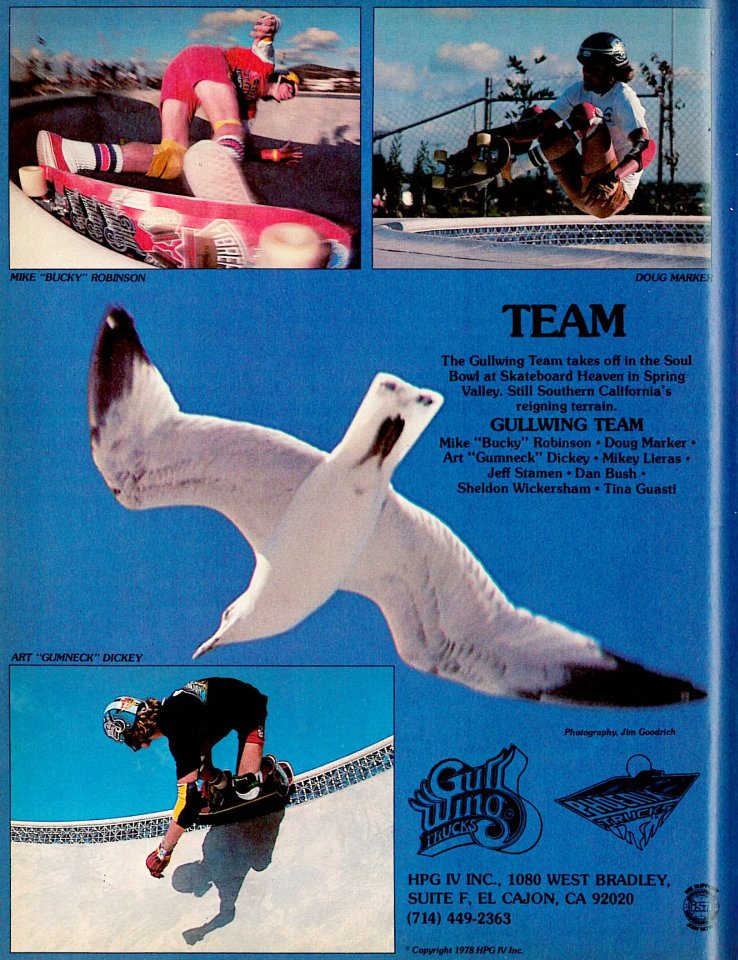
The Gullwing team helped turn the trucks from hardware into mythology. Ben Schroeder, Chris Miller, Tony Magnusson, Jason Jessee, Jeff Kendall, Lee Ralph, David Hackett, and Ray Underhill are among the names closely associated with the brand’s 1980s roster. That list says a lot about Gullwing’s reach. It was not locked into one style. It crossed vert, pools, street, transition, and full-throttle personality skating. Chris Miller brought clean, powerful vert lines. Jason Jessee brought raw style and strange magic. Jeff Kendall and Ray Underhill connected the trucks to the Santa Cruz/Bones Brigade-adjacent world of high-visibility 80s skateboarding. Ben Schroeder and Lee Ralph added pure speed, danger, and punk energy. Gullwing was not just selling metal; it was selling a feeling that the truck underneath you was part of the same chaos you were trying to control.
The brand also had its own video footprint. Gullwing’s 1987 video “Molecules of Motion” belongs to that classic era when truck and wheel companies used skate videos to build identity the same way board brands did. SkateVideoSite lists “Molecules of Motion” as a Gullwing full-length featuring a stacked lineup including Jason Jessee, Ron Allen, Tony Magnusson, Chris Miller, Ben Schroeder, Lee Ralph, Ken Park, Buck Smith, and others. That matters because it shows Gullwing was not a quiet parts supplier hiding underneath someone else’s program. It was participating directly in skate culture, presenting its own riders, and helping define how truck companies could have a voice.
The “truck wars” of the 1970s and 1980s were not a single official battle, but anyone who lived through that era remembers the feeling. Trucks had tribes. Tracker had its own powerful claim, launching in 1975 and building a reputation as one of the first purpose-built skateboard truck companies, with huge sales strength through the late 1970s and 1980s. Independent arrived with a heavy, durable, hard-turning image that became almost religion for pool, vert, street, and later all-around skateboarding. Bennett had earlier carving credibility. ACS and others were part of the mix. Gullwing’s lane was innovation, quick response, distinctive geometry, and unforgettable identity. In the shop, at the ramp, and in magazine setup photos, truck choice became a statement. Riding Gullwings said something different than riding Trackers or Indys. It said you liked speed, carve, colour, experiment, and maybe a little bit of weirdness.
That competition pushed skateboard trucks forward. Tracker’s reputation leaned into being dependable, widely used, and built specifically for skateboarding. Independent became the symbol of durability and raw all-terrain trust. Gullwing answered with signature shapes, grooves, split axle concepts, magnesium experiments, graphite models, street-specific trucks, and longboard-focused reverse-kingpin designs. The Pro III magnesium edition was especially notable, described as a 100% magnesium skateboard truck with a titanium axle, making it one of the lightest trucks of its time. Gullwing also released models such as the Mach IV, identified as the first graphite skateboard truck, along with the Street Shadow, Little G, Spectra, Charger, Stalker, Sidewinder, and Shadow DLX. The brand’s catalogue reads like a company that kept asking, “What else can a truck be?”
The early 1990s brought a brutal shift. Vert shrank, street took over, boards got smaller, wheels got tiny, pants got enormous, and the whole industry had to adjust. Gullwing’s Street Shadow was its answer to that underground street era, with names such as Matt Hensley, Ronnie Creager, Chad Knight, and Chet Thomas connected to that chapter. The Little G followed the shrinking board trend with narrow sizing, while Hurricane Trucks, a Gullwing subsidiary, pushed further into street skating with riders including Willy Santos and Dayne Brummet. Gullwing also reportedly opened up production to multiple upstart truck companies, acting as a manufacturer during a period when the industry was splintering, mutating, and rebuilding from the 1980s crash.
The longboard boom gave Gullwing a way back to its original DNA. Deep carving, downhill, commuting, campus cruising, and surf-style riding all needed trucks that could turn hard while staying composed. The Charger brought Gullwing back toward the split-axle spirit with a reverse-kingpin platform designed for deep turns and high-speed stability. The Stalker added vibration-dampening ideas, while the modern Sidewinder became one of the company’s most distinctive later designs, using two pivot points and a double-stacked bushing system for an exaggerated carving feel. That truck became especially important in the surfskate and carving world because it did not feel like a normal skateboard truck. It felt loose, swoopy, and playful, almost like a mechanical invitation to pump harder and draw deeper lines.
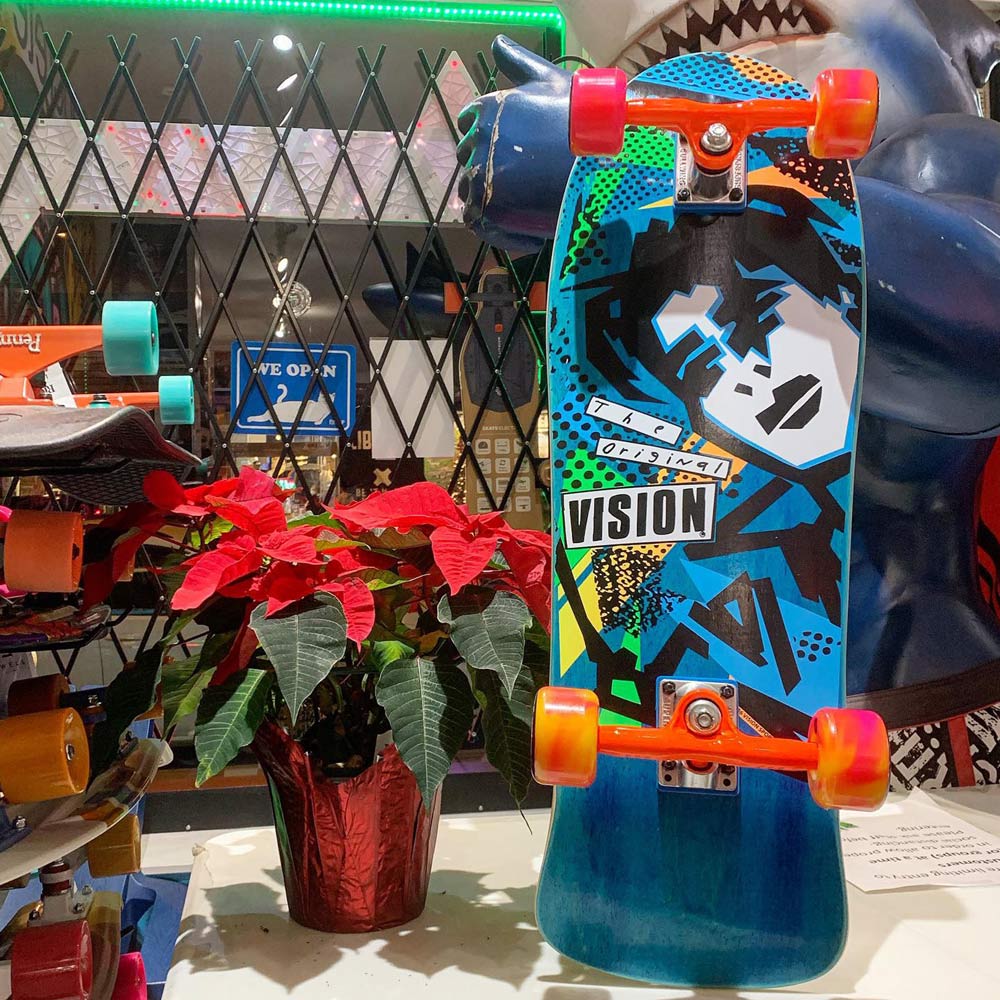
CalStreets has a direct Canadian connection to the Gullwing story because the shop was open through the heart of the 1980s skate explosion, when truck choice was part of every serious setup conversation. Back then, skaters were not just grabbing whatever came on a complete. They were building boards piece by piece, debating decks, wheels, rails, risers, bearings, and trucks like every part had a job to do — because it did. Gullwing Pro III trucks fit perfectly into that era. They had the width, the colour, the recognizable shape, and the attitude to sit under the big Santa Cruz, Powell-Peralta, Vision, Skull Skates, Alva, G&S, and Zorlac-style boards that defined the decade. For a shop like CalStreets, open since 1978 and right in the middle of that boom, Gullwing was part of the real hardware language of the time.
Inside an 80s skate shop, the truck wall mattered. It was where riders made decisions that changed how their boards actually felt. Independent, Tracker, Gullwing, Venture, Thunder, and others all had their loyalists, and Gullwing stood out because it looked and rode differently. The grooved hanger, bold colours, and chunky Pro III profile made them feel right at home on the wide, graphic-heavy boards of the period. At CalStreets, those trucks connect directly to the shop’s original era: the days of big decks, copers, rails, lapper tails, bright wheels, loud grip, Bones Brigade hype, Santa Cruz attitude, and skaters coming in to build something that felt personal. That is why Gullwing still makes sense in the CalStreets Reissue Dept today. It is not just a retro part — it is a piece of the same 1980s shop culture CalStreets lived through the first time around.
Today, Gullwing’s legacy lives in two main ways. First, there is the collector and reissue world, where the Pro III remains a natural match for 1980s-style decks, old-school shapes, and period-correct builds. Second, there is the carving and longboard world, where models like the Charger and Sidewinder connect directly to the brand’s original promise of turning, speed, and control. The reissued Pro III is especially important because it gives modern riders and collectors access to the look and feel of one of the company’s defining trucks without having to hunt down an old pair with decades of mystery wear. For reissue boards, retro cruisers, and wall-worthy builds that still deserve to roll, Gullwing still hits the nostalgia button hard.
Gullwing’s place in skateboard history is not just about one truck or one decade. It is about a company that helped prove skateboard trucks could have personality. They could be technical, strange, colourful, divisive, iconic, and tied to riders in the same way decks and wheels were. The truck wars gave skaters choices, and those choices shaped style. Tracker, Independent, Bennett, Thunder, Venture, Gullwing, and the rest all helped build the language of how skateboards feel underfoot. Gullwing’s contribution was the winged, grooved, experimental side of that language: fast-turning split axles, Phoenix toughness, Pro III attitude, magnesium ambition, Street Shadow adaptation, Sidewinder weirdness, and a team that made the metal matter.
In the end, Gullwing is one of those brands that reminds us skateboarding has always been driven by both function and folklore. The trucks had to work, but they also had to mean something. Gullwing meant speed. It meant carve. It meant 80s colour and coping sparks. It meant truck wars, team ads, video parts, and the strange loyalty skaters develop for the gear that carried them through their first real turns, first grinds, first hills, and first proper slams. From California innovation to Canadian hills, from Pro III reissues to Sidewinder surfskate carve machines, Gullwing remains one of skateboarding’s most recognizable hardware names — proof that even the parts underneath the board can become legends.