


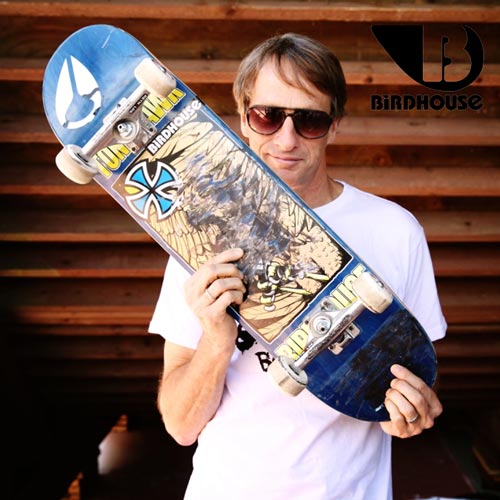


 Birdhouse Skateboards was founded in 1992 by Tony Hawk and Per Welinder, at a moment when skateboarding was in one of its roughest downturns. The vert boom had faded, the industry was shrinking, and many of the biggest names from the previous decade were suddenly trying to figure out what came next. Instead of waiting for skateboarding to come back around, Hawk and Welinder built something of their own. Birdhouse began as Birdhouse Projects, a skater-owned company with a simple idea behind it: gather a team of dedicated riders, keep making videos, keep making boards, and keep skating even when the business side looked grim. Birdhouse’s own history points to those early years as a time when the team was led by Hawk and included Jeremy Klein, Steve Berra, and Willy Santos, before later waves brought in riders like Ocean Howell, Matt Beach, Paul Zitzer, Andrew Reynolds, Brian Sumner, Steve Nesser, Bucky Lasek, and Heath Kirchart.
The name Birdhouse fit Tony Hawk perfectly. Hawk was already “The Birdman,” and the company gave that identity a home, but Birdhouse was never just a Tony Hawk logo on a deck. From the beginning, it mixed vert, street, humour, video culture, and oddball graphics into something more flexible than a standard superstar brand. Hawk gave Birdhouse instant credibility, but the company’s personality came from the crew around him. It had the mainstream reach of the most famous skateboarder in the world, but it also had the loose, goofy, sometimes chaotic energy of a small skate company trying to invent itself as it went.
Jeremy Klein was one of the key figures in shaping that early identity. Before Birdhouse, Klein had already made his name as one of the original World Industries riders, coming out of the late ’80s and early ’90s period when street skating was getting stranger, more technical, and more personality-driven. At Birdhouse, he became much more than another rider on the team. Klein’s skating had a dry, stylish, prankish quality, and that attitude carried naturally into the way Birdhouse looked and felt. He brought a cartoon-minded, anti-boring visual sense that helped separate Birdhouse from cleaner, more traditional skate brands.
Klein’s importance is easiest to understand if you look at the world he built around himself. In 1993, he created Hook-Ups, a brand known for Japanese animation-inspired characters, bright graphics, monsters, and a visual language that was wildly different from most skate art of the period. Hook-Ups began as a T-shirt idea and grew into skateboards, shoes, accessories, and a collector-heavy graphic universe of its own. The brand sat close to the Birdhouse and Blitz Distribution orbit, and it showed what Klein understood early: skateboard graphics did not have to be skulls, flames, logos, or tough-guy imagery to be powerful. They could be weird, playful, colourful, awkward, funny, and instantly recognizable from across the shop wall.
That approach fed back into Birdhouse. Klein’s later role around Birdhouse art direction helped give the brand some of its stranger flavour: cartoon chaos, odd mascot energy, toy-box humour, and graphics that felt built for skaters who liked their decks with a little mischief baked in. Even today, Birdhouse still leans into that tradition. Modern decks like the David Loy Toy Invasion keep that cartoon-heavy spirit alive, with Jeremy Klein artwork giving the board a loud, animated, character-packed feel that connects directly back to the brand’s weirder visual roots.
Birdhouse’s early videos were essential to building the brand. In the early ’90s, skate companies lived and died by video, and Birdhouse used that format to prove it was more than a Tony Hawk side project. Videos like Feasters, Ravers, and the early Birdhouse Projects releases helped establish the team’s tone, mixing serious skating with the kind of loose humour that made the company feel approachable. The early videos layouts show how those early Birdhouse Projects videos featured overlapping crews of vert and street riders, including Tony Hawk, Jeremy Klein, Willy Santos, Heath Kirchart, Matt Beach, Ocean Howell, and others.
Then came The End in 1998, the Birdhouse video that turned the company’s weirdness into a landmark. Directed, produced, and edited by Jamie “Mouse” Mosberg, The End was not just another full-length team video. It was big, cinematic, chaotic, expensive-looking for skateboarding at the time, and packed with skits, storylines, explosions, stunts, and personality. SkateVideoSite lists The End as a 1998 Birdhouse full-length featuring riders including Brian Sumner, Heath Kirchart, Willy Santos, Andrew Reynolds, Rick McCrank, Jeff Lenoce, Tony Hawk, Steve Berra, Bucky Lasek, Jeremy Klein, and Ali Cairns.
The Jeremy Klein and Heath Kirchart section in The End remains one of the most remembered parts in Birdhouse history. It was not just about trick difficulty, although the skating was there. It was about concept. Klein and Kirchart turned the city into a strange playground of business signs, rooftops, walls, props, and built-out surfaces, creating a section that felt like street skating mixed with a prank film and a controlled demolition. Instead of simply showing spots, the part treated the environment like something that could be modified, mocked, attacked, and reimagined. It captured Klein’s creative brain perfectly: skateboarding as art direction, stunt work, comedy, and vandal theatre all at once.
That is why The End matters so much to the Birdhouse story. It gave the brand a mythology beyond Tony Hawk. Hawk’s vert presence was still central, but the video showed that Birdhouse could produce cultural moments through its street riders too. Andrew Reynolds had a breakout presence. Heath Kirchart and Jeremy Klein created one of the most visually memorable shared parts of the era. Bucky Lasek represented elite transition skating. The whole thing felt like Birdhouse announcing that it had grown from a survival-era startup into a major skate company with its own cinematic universe.
One year later, Tony Hawk landed the 900 at the 1999 X Games in San Francisco, and Birdhouse was suddenly attached to one of the most famous moments in skateboarding history. The trick — two and a half rotations above a vert ramp — had been chased for years, and when Hawk finally rolled away, it became a mainstream sports highlight as much as a skateboarding milestone. The board he rode was a Birdhouse Falcon 2, and that detail permanently welded Birdhouse to the 900 story. In 2025, that same Birdhouse Falcon 2 sold at auction for $1.15 million, becoming the most expensive piece of skateboard memorabilia ever sold.
The 900 arrived at the perfect cultural moment. The X Games were pushing action sports into living rooms, skateboarding was about to explode through the Tony Hawk’s Pro Skater video game series, and Birdhouse suddenly had the kind of visibility that most skate companies could never buy. For many kids, Birdhouse was not discovered through a shop wall, a magazine ad, or a borrowed VHS tape. It was discovered through Tony Hawk becoming a household name. That exposure gave Birdhouse a place in mainstream skate history, but the brand’s deeper credibility still came from the videos, the team, and the oddball personality behind the graphics.
Jeremy Klein’s legacy inside Birdhouse is especially important because he connects the brand’s skating, art, humour, and collector appeal. As a rider, he was part of the original foundation. As the mind behind Hook-Ups, he expanded what skate graphics could look like. As an art-director figure within the Birdhouse world, he helped keep the brand from becoming too plain, too corporate, or too dependent on Hawk alone. Klein’s influence shows up in the way Birdhouse has continued to embrace cartoons, monsters, toys, strange characters, and graphics that feel like they belong to skateboarding’s funnier, weirder side.
Birdhouse has also survived because it has always been able to bridge eras. The early ’90s Birdhouse Projects period gave it roots. The End gave it legend. The 900 gave it global recognition. The video game era gave it mass exposure. Later teams kept the name active through changing skate trends, from big gaps and rails to transition skating, mega ramps, park terrain, and modern contest skating. Many brands from the same period disappeared, folded, or became nostalgia shells, but Birdhouse kept flying because it had real history and a founder whose name never drifted away from skateboarding.
The team today continues that multi-generation identity. Birdhouse’s current official team list includes Tony Hawk, Lizzie Armanto, Tom Schaar, Tate Carew, Reese Nelson, Felipe Nunes, Aaron “Jaws” Homoki, David Loy, Shawn Hale, and Elliot Sloan. That roster says a lot about what Birdhouse is now: Hawk remains the anchor, Lizzie Armanto brings modern transition power and international respect, Tom Schaar and Elliot Sloan keep the big-ramp lineage alive, Jaws represents full-impact insanity, Felipe Nunes brings one of the most inspiring adaptive skateboarding stories in the world, and David Loy keeps the raw street personality burning.
That mix makes Birdhouse more than a nostalgia brand. It can still sell the memory of Tony Hawk, Jeremy Klein, The End, Hook-Ups, and the 900, but it also has a present-day team that speaks to where skateboarding has gone. Birdhouse started during a low point, became part of skateboarding’s biggest mainstream explosion, and still carries the strange cartoon DNA that made it stand out in the first place. Its story is not just about flight. It is about refusing to crash when the industry did, building a crew when skateboarding needed one, turning chaos into art direction, and leaving behind some of the most recognizable moments in modern skateboard history. Birdhouse remains one of skateboarding’s great survivor stories: a company born during hard times, lifted by Tony Hawk’s impossible flight, shaped by Jeremy Klein’s strange cartoon universe, and kept alive by generations of riders who still make the brand feel fun, fearless, and unmistakably skateboarding.

